The EDSA People Power anniversary, marked every February 25, commemorates the four days in February 1986 when millions of Filipinos gathered on Epifanio de los Santos Avenue (EDSA) in Metro Manila and peacefully ended the 20-year rule of President Ferdinand Marcos. On February 25, 1986, Corazon Aquino was sworn in as president and the Marcos family left the country. Whether the day is a holiday, and what kind, is decided by presidential proclamation each year.
Below is a simple, day-by-day account of what happened, how the anniversary is observed now, and what People Power can teach young Filipinos.
The road to EDSA
Ferdinand Marcos was elected president in 1965 and declared martial law in 1972. Under martial law, Congress was closed, critics were jailed and press freedom was sharply limited. Even after martial law was formally lifted in 1981, Marcos kept wide powers.
In August 1983, opposition leader Benigno "Ninoy" Aquino Jr. was shot dead at the Manila airport as he returned from exile in the United States. His death shocked the nation and drew huge crowds into the streets. His widow, Corazon "Cory" Aquino, a homemaker with no political experience, became the face of the opposition.
The 1986 snap election
Under growing pressure, Marcos called a snap presidential election for February 7, 1986. Cory Aquino ran against him. The official count declared Marcos the winner, but the citizen watchdog NAMFREL's count had Aquino ahead, and there were widespread reports of cheating, vote-buying and violence. Doubts about the result set the stage for what came next.
Four days in February: what happened at EDSA
February 22, 1986
Defense Minister Juan Ponce Enrile and Armed Forces Vice Chief of Staff Lt. Gen. Fidel V. Ramos broke away from Marcos. From Camp Aguinaldo, they announced their defection and called on Marcos to step down. That night, Manila Archbishop Jaime Cardinal Sin went on Radio Veritas and urged people to go to EDSA to support and protect them.
February 23, 1986
Thousands answered the call. Ordinary citizens, priests, nuns, students and families filled EDSA between Camp Aguinaldo and Camp Crame. Enrile moved to Camp Crame to join Ramos. When tanks and troops loyal to Marcos approached, people formed human barricades in front of them, offering food, flowers and prayers.
February 24, 1986
The crowds grew even larger. Government forces tried to break them up, but many soldiers refused to fire on unarmed civilians and some switched sides. Marcos insisted on television that he would not resign.
February 25, 1986
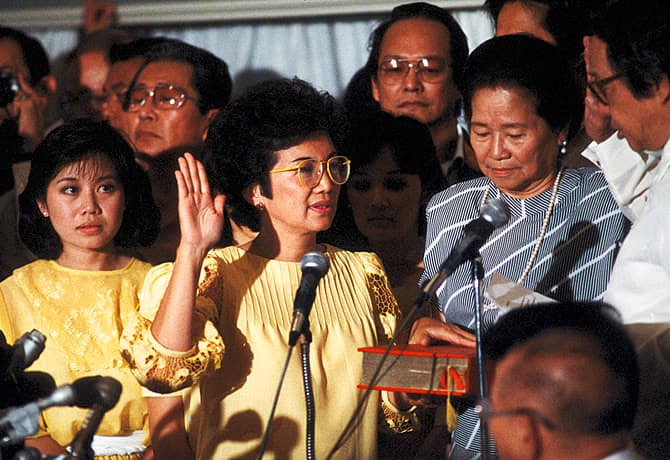
Corazon Aquino was sworn in as president at Club Filipino in San Juan, with Salvador Laurel as vice president. Marcos held his own inauguration at Malacañang the same day. That night, the Marcos family left the palace by helicopter, flew to Clark Air Base and, from there, went into exile in Hawaii. Cory Aquino became the country's 11th president and its first woman president.
For a closer look at the details, Carlos Hilado Memorial State University, a Western Visayas state university, has a clear day-by-day summary, and The Philippine Star has a list of lesser-known facts.
Why People Power was remarkable
The EDSA revolution drew attention around the world for several reasons:
- It was largely peaceful. Facing tanks and armed troops, the crowds stood their ground with rosaries, songs and flowers, and a bloodbath was avoided.
- It was led by ordinary people. Soldiers, church leaders and politicians played key roles, but it was the crowds of civilians who made the difference.
- It inspired others. "People Power" became a phrase used worldwide for peaceful movements for change.
The symbols of EDSA are still familiar: the color yellow, the "L" hand sign for Laban (fight), and the song "Bayan Ko."
How the EDSA People Power anniversary is observed today
The EDSA People Power anniversary is not one of the regular holidays listed in Republic Act No. 9492. Instead, the President decides each year whether to declare it a special non-working day, a special working day or neither.
Recent years show how this changes:
- In 2024, the anniversary fell on a Sunday and was not included in the official list of holidays.
- In 2025, it was declared a special working day.
- In 2026, the 40th anniversary, Proclamation No. 1006 declared Wednesday, February 25, a special working day.
A special working day means offices, schools and businesses generally stay open, while the anniversary is still officially commemorated. For pay, DOLE's guidance is what counts, so check its advisory for the year rather than assuming holiday rates apply.
The main commemoration usually takes place at the People Power Monument and the EDSA Shrine along EDSA in Quezon City, with flag ceremonies, Masses and programs. Schools and civic groups across the country often hold their own activities.
Ways to mark the anniversary
- Ask someone who remembers. Many parents and grandparents followed EDSA on the radio or watched it on television. Ask them where they were and how it felt.
- Read from more than one source. EDSA is still debated. Read accounts from different sides, check facts and form your own view.
- Watch out for fake history. Misleading posts about martial law and EDSA spread widely online. Check claims against reputable sources before you share.
- Practice active citizenship. Register to vote, attend a barangay assembly or join a civic group. People Power was a moment; citizenship is every day.
- Talk about it peacefully. Families and barkadas may disagree. Listen first, and keep the conversation respectful.
What EDSA means for young Filipinos
Most Filipinos alive today were born after 1986. For them, EDSA can feel like a chapter from a textbook. Yet its core lesson is timeless: when citizens act together, peacefully and with courage, they can shape their country's future.
In Hiligaynon, we speak of paghiliusa, or unity. EDSA showed what unity can do. The same spirit can power smaller acts of change in our own communities, from a coastal clean-up to a youth leadership program. If you want to turn civic spirit into action, our guide on how to start community development work is a practical place to begin, and our overview of NGOs and youth organizations in the Philippines shows where you can plug in.
EDSA is also one chapter in a longer story of Filipinos standing up for freedom, from the Katipunan to Bataan. Read about earlier chapters in our guides to Bonifacio Day and Araw ng Kagitingan.
Frequently asked questions
Is the EDSA People Power anniversary a holiday?
It depends on the year. The President decides by proclamation. In 2025 and 2026 it was a special working day, meaning work and classes generally continued.
What does EDSA stand for?
EDSA stands for Epifanio de los Santos Avenue, the main highway in Metro Manila where the crowds gathered. It is named after Epifanio de los Santos, a Filipino historian and writer.
How long did the EDSA People Power Revolution last?
Four days, from February 22 to February 25, 1986.
Who became president after EDSA?
Corazon Aquino, who was sworn in on February 25, 1986, and served until 1992.
Keep the spirit of People Power alive
People Power began with ordinary citizens who decided to show up. JCI Roxas Halaran is a community of young Capiznon men, aged 18 to 40, who show up for their province through leadership and service. Join us or see our projects to find your place.